
What Germany's 2045 Fossil Fuel Exit Roadmap Really Commits To
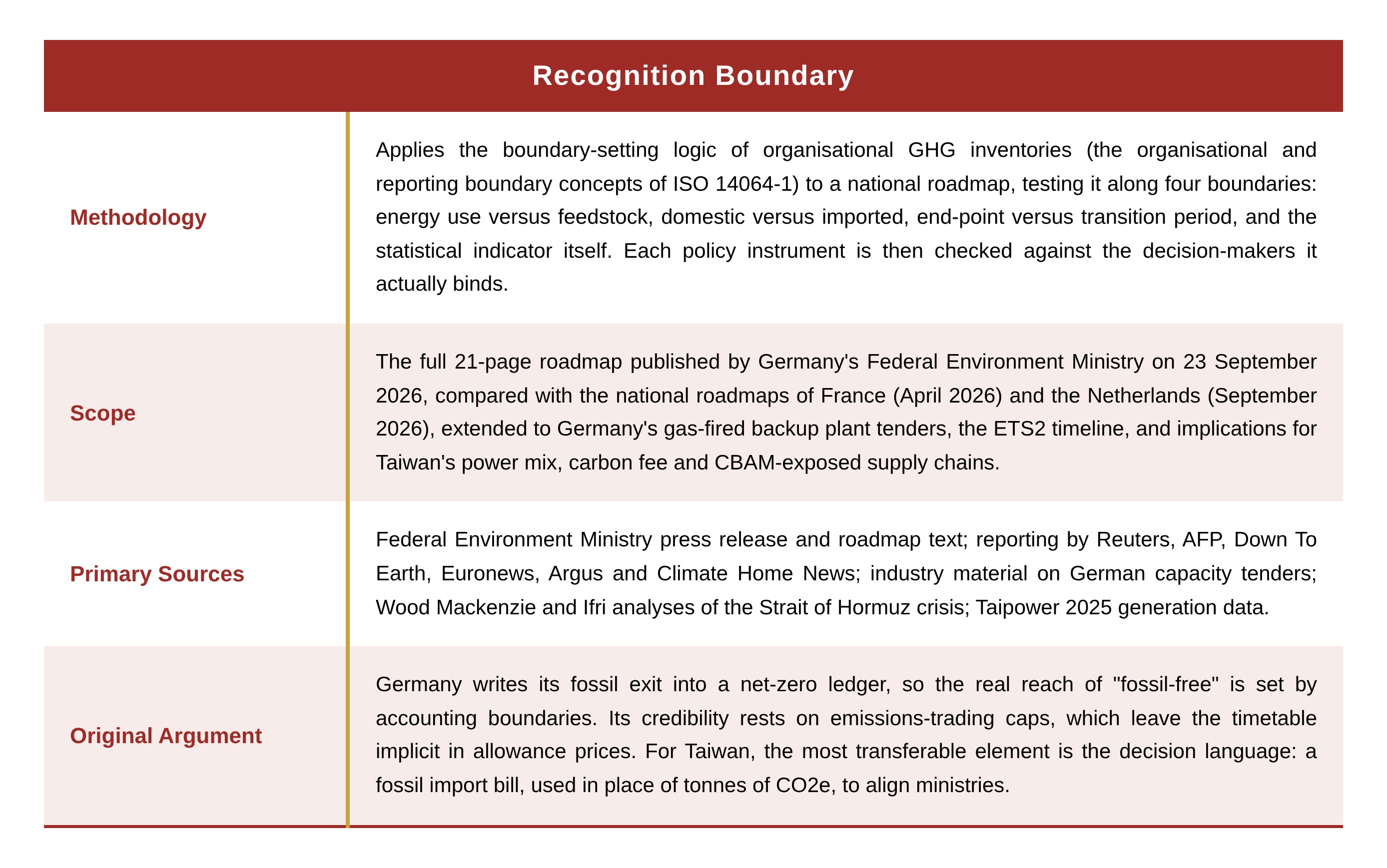
The fossil-free promise in Germany's 2045 roadmap reaches only as far as its accounting boundaries. The roadmap restates the net greenhouse gas neutrality target of the Federal Climate Action Act in the language of a fossil exit, so residual fossil use remains permissible on the books wherever it is offset by sinks or carbon capture. To read any national fossil phase-out roadmap, check where it draws four boundaries: energy versus feedstock, domestic versus imported, end-point versus transition period, and final versus primary energy. The headline year tells you comparatively little.
I. Core Claim
Germany’s 2045 roadmap for transitioning away from fossil fuels restates, in the vocabulary of a fossil exit, the net greenhouse gas neutrality target already written into the Federal Climate Action Act, which means the reach of its “fossil-free” promise depends entirely on where the accounting boundary is drawn. Only the power sector is explicitly committed to fossil-free generation by 2045. Every other sector ends at climate neutrality, and fossil hydrocarbons used as industrial feedstock, carbon capture for hard-to-abate industry, imported blue ammonia, and newly installed boilers that may still burn fossil fuel until 2045 all sit outside the boundary, or are allowed to stay on it until the final year. Where France sets a phase-out year for each fuel, Germany stakes its credibility on the declining caps of the EU Emissions Trading System, so the timetable is implicit in allowance prices and never appears as a statutory date. For Taiwan, the most valuable lesson lies in the decision language. Germany places an annual fossil import bill of roughly EUR 76 billion at the centre of its argument, so that finance, industry and security ministries can all see why the exit matters. In a country where gas supplies more than half of all electricity and which has just come through the Hormuz crisis, that language persuades far better than any tonnage figure.
II. Context
1. From COP28 paragraph 28(d) to Santa Marta
Paragraph 28(d) of the COP28 global stocktake decision in Dubai called on Parties to transition away from fossil fuels in energy systems, in a just, orderly and equitable manner, accelerating action in this critical decade so as to achieve net zero by 2050 in keeping with the science. Two qualifiers in that sentence are easy to overlook, “in energy systems” and “net zero”, and both later became the basis on which Germany defined the scope of its roadmap.
COP30 in Brazil in 2025 had a chance to turn that sentence into a global roadmap but failed to reach consensus, and the Brazilian Presidency instead undertook to publish an international roadmap ahead of COP31. France’s envoy Benoit Faraco later explained that the blockage at COP30 was precisely why France chose to move first on its own. Willing countries then looked outside the convention process: in April 2026, Colombia and the Netherlands co-chaired the First International Conference on Transitioning Away from Fossil Fuels in Santa Marta, attended by 57 governments including Germany. Three workstreams emerged (national roadmaps, finance, and partnerships), and the next conference will be co-hosted by Tuvalu and Ireland in 2027.
2. The timing at the UN General Assembly
The German cabinet approved the roadmap on the morning of 23 September 2026, and Federal Environment Minister Carsten Schneider presented it on the sidelines of the UN General Assembly in New York later that day. On the same day, in his last address to the General Assembly, Secretary-General António Guterres for the first time called on every country to submit a national roadmap for ending fossil fuel production and consumption, with clear timelines and protections for affected workers. Germany thus became the third country, after France and the Netherlands, to present such a plan, less than two months before COP31 in Antalya, Türkiye, on 9 to 20 November. The political choreography was deliberate.
3. How the Hormuz crisis shifted the argument
The roadmap was born against the backdrop of the blockade of the Strait of Hormuz that began in spring 2026. The European Commission estimates the blockade has added about EUR 50 billion to the EU’s fossil fuel import costs, and the German environment ministry notes that the country’s import bill has risen sharply since the Iran crisis. In presenting the plan, Schneider tied the affordability of daily commutes directly to events in the Strait, arguing that the case for breaking fossil dependence now extends beyond climate to independence and affordability. That backdrop explains why the document reads more like an economic security strategy, with climate outcomes presented as one result among several.
III. What the Roadmap Contains
1. Structure and baseline
The roadmap runs to 21 pages, covering international dynamics, the current state of fossil fuel use in Germany, an overview of climate policy, measures in four sectors, carbon pricing, research and innovation, the social design of the transition, and Germany’s international action. The baseline is candid. In 2024 fossil fuels still accounted for almost 65% of German final energy consumption: mineral oils 36%, gases 24% and coal about 5%. Fossil combustion produced more than 83% of national greenhouse gas emissions. Import dependence is even more striking: about 98% of mineral oils and 95% of natural gas are imported, as is all hard coal, leaving lignite as the only fully domestic fuel.
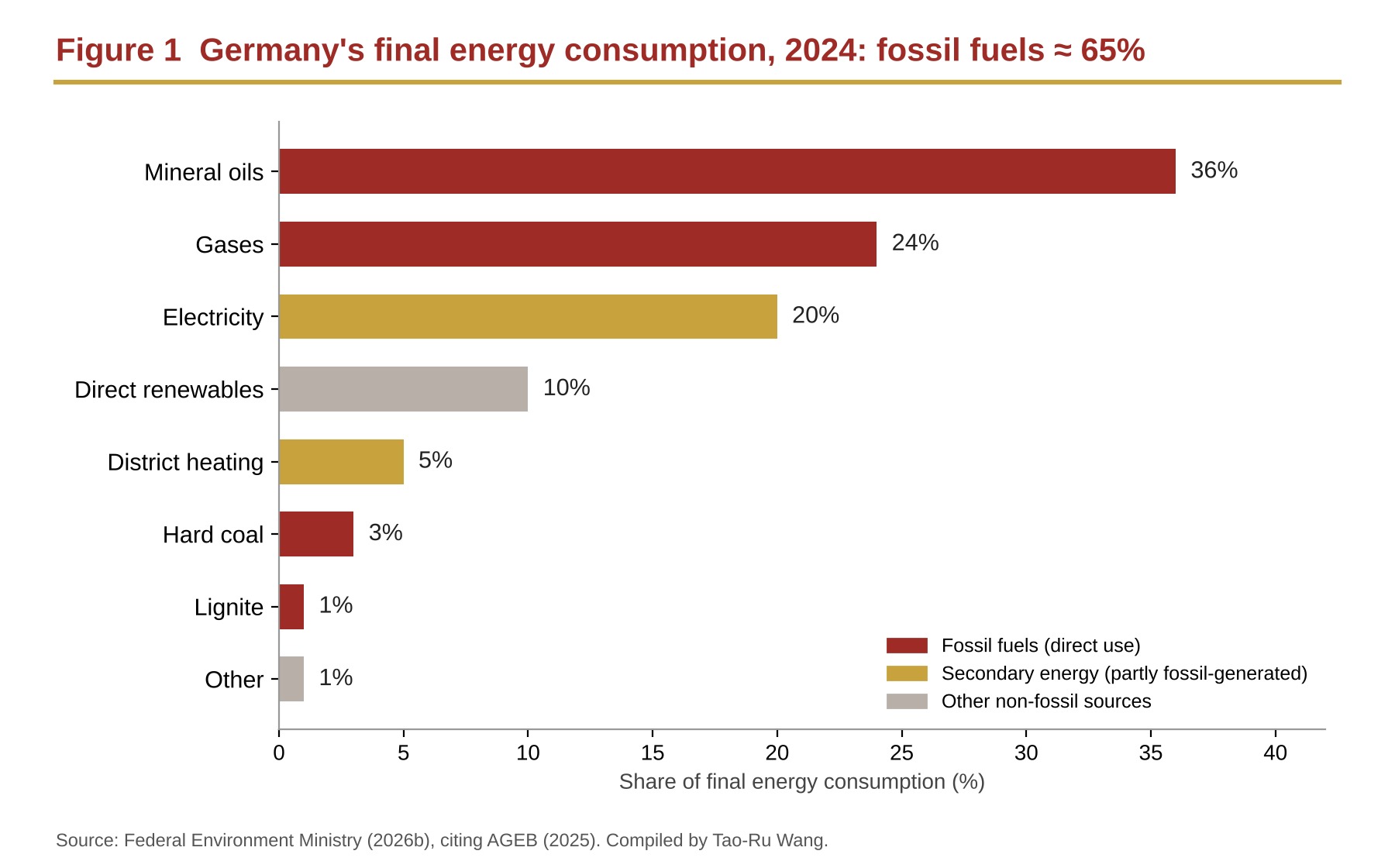
Note: electricity and district heating are secondary energy carriers still produced in significant part from coal and gas, so the 65% figure, measured on final energy, understates the energy system’s real dependence on fossil fuels.
Germany’s net fossil fuel imports cost about EUR 76 billion in 2024: roughly EUR 51 billion for oil and petroleum products, EUR 19 billion for gases and almost EUR 5 billion for coal and coke. The roadmap places this bill at the heart of its baseline chapter and attaches an import saving to its measures. The 67 measures of the 2026 Climate Action Programme, for example, are expected to save almost seven billion cubic metres of natural gas and about four billion litres of petrol by 2030, while tenders for some 2,000 additional wind turbines (12 GW) would save about EUR 1 billion a year in gas imports.
2. Sector targets and policy instruments
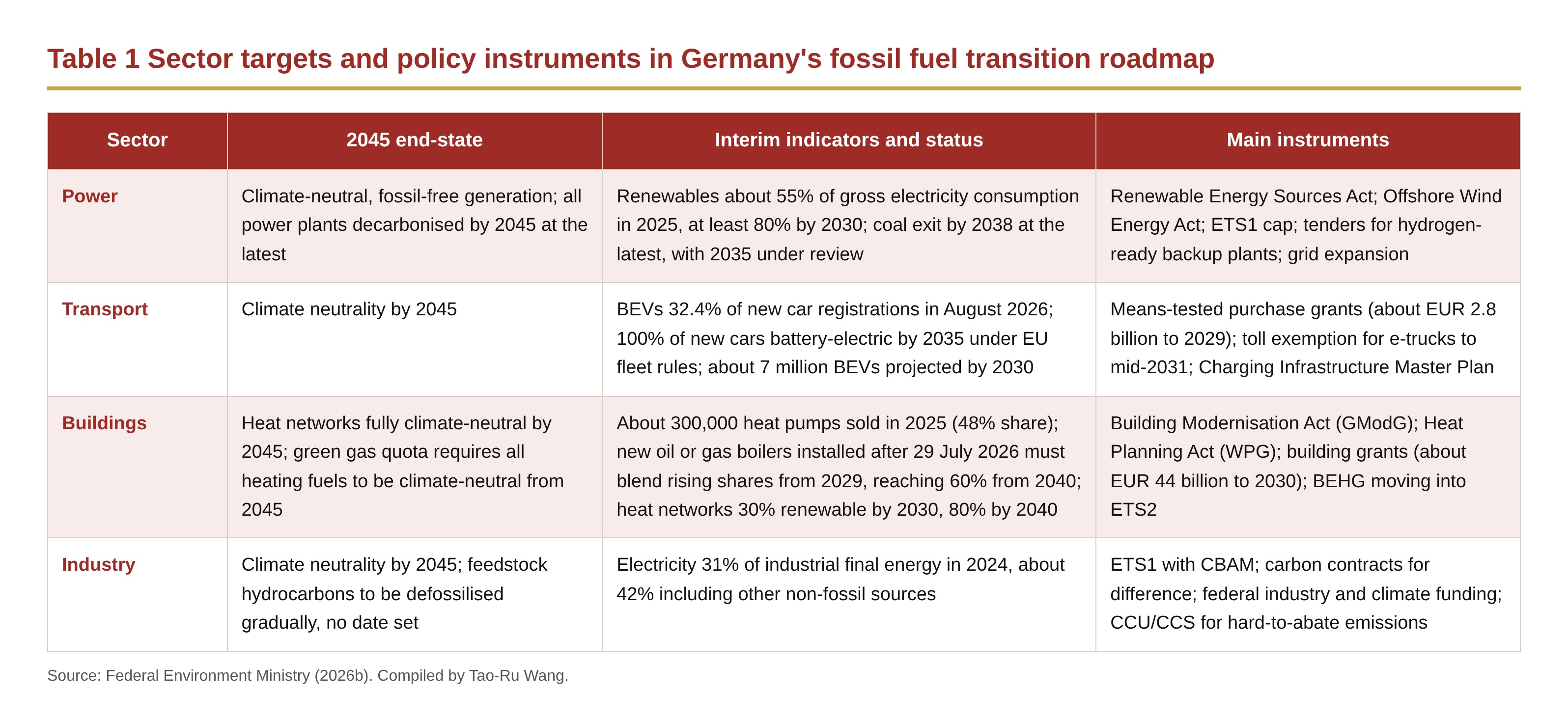
Electrification is the common thread. The roadmap stresses repeatedly that electric cars and heat pumps are far more efficient than their fossil alternatives, and that each new heat pump or electric car means one less share of imported oil or gas. The transport and buildings narratives rest on market turning points that have already happened: in 2025 heat pump sales overtook gas boilers for the first time, and in August 2026 battery-electric cars passed 30% of new registrations. Policy here acts mainly as an accelerant and a gap-filler. Power-sector targets are the most concrete, since a clean grid is the precondition for every other sector’s exit.
3. Carbon pricing carries the load
According to the roadmap, about 85% of German emissions are already covered by the EU Emissions Trading System or by national emissions trading. ETS1 has covered large energy and industrial installations since 2005, and ETS2 will become fully operational in 2028, taking over buildings and road transport emissions currently covered by Germany’s national scheme (BEHG). From the trading period beginning in 2031, the caps of both systems will be aligned with the EU’s 2040 target of a 90% cut. The roadmap’s logic is that falling caps make rising carbon prices for fossil fuels inevitable in every covered sector, squeezing them out over time. Put differently, Germany sets no phase-out year for oil or gas because it considers the cap to have set one already.
4. A quarter of the document faces outward
A full chapter is devoted to Germany’s international role: EUR 11.8 billion in international climate finance in 2024, about EUR 3.9 billion of it for energy transitions in partner countries; pledges of about EUR 5.4 billion to the Just Energy Transition Partnerships with South Africa, Indonesia, Vietnam and Senegal; bilateral energy partnerships with 33 countries; and the 2023 exit from the Energy Charter Treaty. The chapter is a reminder that Germany wrote the roadmap as an international exemplar, which makes external consistency a second yardstick against which to judge it.
IV. Recognition Boundary Analysis: Where Net Zero and Fossil Exit Diverge
1. The legal anchor is still net GHG neutrality
The roadmap’s legal anchor is the Federal Climate Action Act, which requires cuts of at least 65% by 2030 and 88% by 2040 against 1990, net greenhouse gas neutrality by 2045 and net negative emissions after 2050. The summary is explicit: it sets out how Germany will achieve climate neutrality “and thus” transition away from fossil fuels no later than 2045. That “and thus” is the key to the document. The fossil exit is a derivative of the net-zero target, with no independent constraint of its own. A net ledger allows residual fossil emissions to be balanced by forest sinks or technological removals, which is why several outlets and analysts have noted that the roadmap sets no hard deadline for ending all fossil fuel use in 2045. The “full phase-out” of the headlines is, on the books, a net figure brought to zero.
2. First boundary: energy use versus feedstock
The COP28 decision confines the transition to “energy systems”, and the German roadmap follows that scope faithfully. Its industry chapter states plainly that hydrocarbons will continue to be needed for material applications and asks only that they be defossilised gradually, with no date attached. For Germany, home to Europe’s largest chemical industry, naphtha and other feedstocks represent a substantial fossil flow, yet in the energy balance they count as non-energy use and never enter the denominator of an energy-system exit. The carbon in those feedstocks does not disappear. It returns as emissions when products are incinerated at end of life, booked in the waste sector, so part of the fossil carbon simply moves from the energy ledger to the waste ledger. Anyone familiar with corporate inventories will recognise the pattern: it resembles the effect of drawing a category of emissions into or out of a reporting boundary. The numbers are accurate; the boundary decides which question they answer.
3. Second boundary: the national border
National greenhouse gas inventories under the UNFCCC follow the territorial principle and count only emissions released within national territory. In its energy partnership chapter, the roadmap lists as a success the first trial shipment of blue ammonia from the United Arab Emirates to Hamburg. Blue ammonia is made from natural gas with carbon capture, and both the capture losses and the upstream methane leakage stay in the exporting country’s inventory. A Germany that is fossil-free on paper can therefore continue to consume molecules derived from fossil gas. In corporate inventory terms, the national roadmap offers a Scope 1 and Scope 2 view with no mechanism equivalent to upstream Scope 3 categories. Critics point in the same direction, citing long-term LNG contracts signed by RWE and SEFE for supplies from Louisiana and Texas, and continued German investment in overseas terminals and gas-fired plants. The roadmap itself concedes that fossil fuels will be used during a transitional period, which is why Germany, as a Global Methane Pledge Champion, commits to tackling methane from fossil fuel production.
4. Third boundary: time
The roadmap is precise about the end-point and deliberately loose about the trajectory. New state-supported backup plants must be hydrogen-ready and climate-neutral in operation by 2045 at the latest. Oil or gas boilers installed after 29 July 2026 must blend in climate-neutral fuels from 2029, but only 60% from 2040, leaving 40% that may still be fossil until the green gas quota pulls all heating fuel to climate neutrality in 2045. The design permits fossil use, legally, right up to the final year. 2045 becomes a cliff with no ramp leading to it. For investors and households, the rules governing the transition period are what shape today’s decisions, and the end year itself binds them relatively little.
5. Fourth boundary: the statistical indicator
The widely cited figure of 65% fossil share is measured on final energy consumption. Electricity (20%) and district heating (5%) within final energy are secondary carriers still produced in significant part from coal and gas, so a primary energy measure would show a noticeably higher fossil share. More telling, France’s roadmap uses the same final-energy basis yet sets interim targets of 40% fossil share by 2030 and 30% by 2035. Germany’s roadmap has no comparable interim fossil-share indicator, only emissions percentages and technology deployment figures. Without a fossil consumption curve that can be tracked year by year, outside observers can only infer progress indirectly from emissions data. This is the document’s clearest weakness in verifiability.
V. Comparing the French, Dutch and German Roadmaps
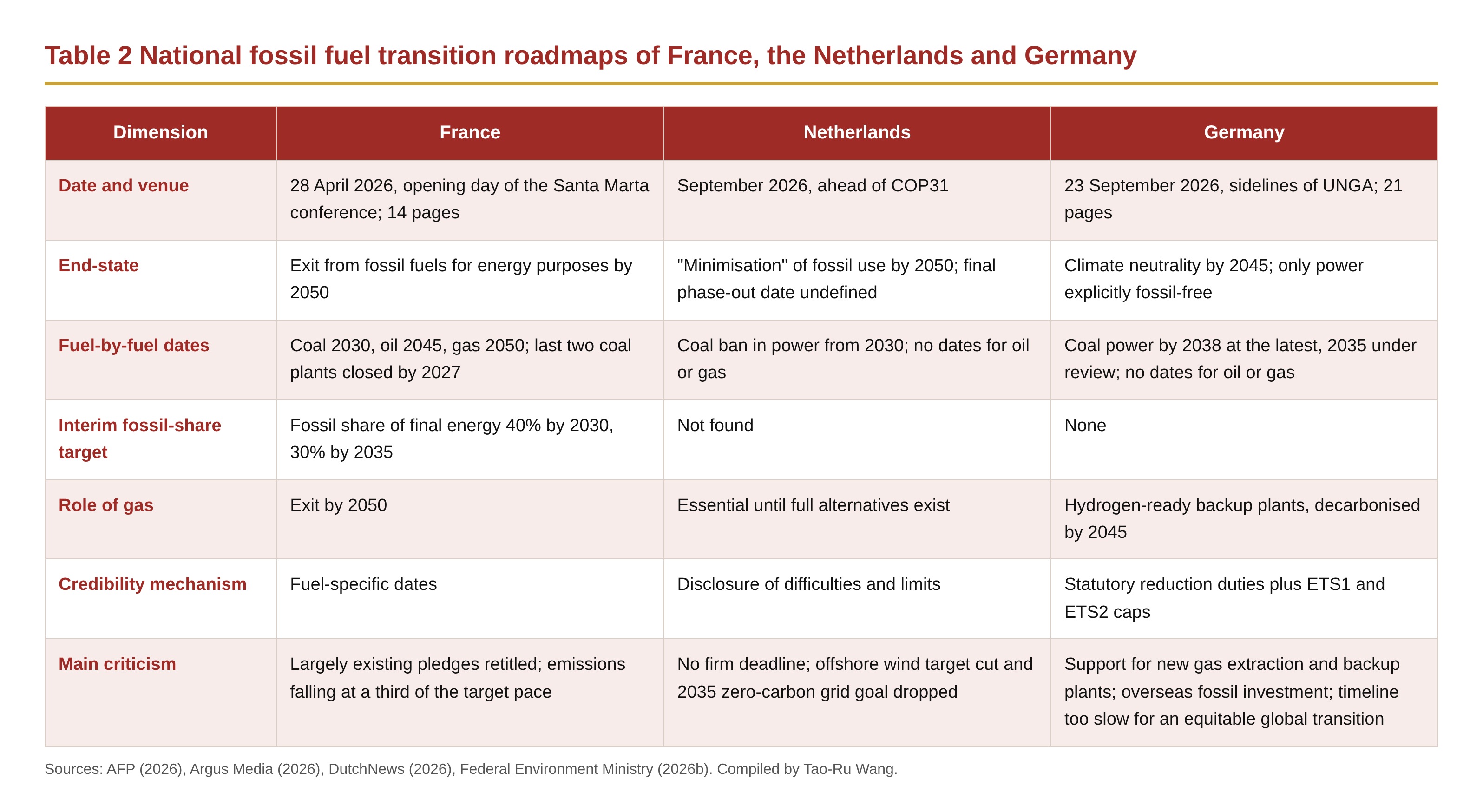
The three documents represent three archetypes. France’s is date-based, setting an exit year for each fuel. It sends the strongest political signal, though delegates in Santa Marta noted that much of it repackaged existing pledges, and actual emissions are falling far more slowly than France’s own targets. The Netherlands’ is disclosure-based, candidly describing the role gas plays in balancing a renewables-heavy grid and the problem of spreading gas network fixed costs across a shrinking customer base. The price of that candour is the absence of any final deadline, while offshore wind ambitions were cut in the same period.
Germany’s is ledger-based. Exit dates appear nowhere in the roadmap. They are left to be derived from statutory reduction duties and emissions-trading caps. Each archetype changes different people’s decisions. A date-based roadmap mainly binds the government itself, because missed dates carry a political cost. A disclosure-based roadmap improves the quality of public debate by making trade-offs visible to stakeholders. A ledger-based roadmap transmits pressure directly to every power plant, factory and fuel supplier holding emission allowances, and its force depends on whether the cap can be defended politically. Leo Roberts of E3G argues that a roadmap should make the fossil exit a central planning principle around which other policies gravitate. By that standard, Germany’s document rearranges existing climate policy more than it establishes the fossil exit as a new planning axis.
VI. Three Pressure Points on Credibility
1. Gas backup plants and a hydrogen market that does not yet exist
The promise of fossil-free power by 2045 rests on a fleet of gas plants, not yet built, switching to green hydrogen on time. Under Germany’s power plant security of supply legislation, the Federal Network Agency has launched a first tender for 4.5 GW of de-rated capacity with a price cap of EUR 244,000 per MW, with further rounds scheduled for 29 December 2026 and 18 May 2027. Every new plant bidding for a capacity contract must be hydrogen-ready and online by November 2031. The first round also requires delivery of 80% of capacity for ten hours, a long-duration criterion that battery storage can barely meet.
The problem is the conversion date. Economy Minister Katherina Reiche has said publicly that the hydrogen volumes needed are unlikely to be available within five years, so gas plants are required for security of supply, failing which coal plants would have to run longer. Uniper’s chief executive welcomed the flexibility of letting operators decide when to switch. The utility association BDEW put it most bluntly: nobody will build a gas plant that is no longer economically viable in twenty years. Taken together, these statements mean the 2045 decarbonisation pledge pushes conversion risk onto a hydrogen market that has yet to take shape. If green hydrogen costs and supply disappoint, the likeliest outcome is pressure to extend the conversion deadline, opening a gap in the one sector the roadmap explicitly declares fossil-free.
2. ETS2 and social tolerance
The exit momentum in buildings and transport depends heavily on ETS2, which becomes fully operational in 2028, a year later than originally planned. Once carbon prices reach heating bills and pump prices, political pressure flows back to national governments, so the roadmap cushions the impact with means-tested grants and adopts technology neutrality in building rules, allowing new gas and oil boilers. A policy expert at 350.org has also warned that cuts in the draft 2027 federal budget could affect international climate finance. Grants are constrained by budgets while carbon prices are set by markets, and when both come under strain the first casualty is usually the stringency of the cap. This is where a ledger-based roadmap is most fragile.
3. Cabinet divisions and external consistency
On the day of approval, Reuters reported calls from conservatives including Reiche for more flexibility on cars, heating and carbon pricing, including a larger role for combustion-engine vehicles running on alternative fuels, which sits uneasily with the roadmap’s expectation of 100% battery-electric new cars by 2035. External consistency faces a similar test. Germany has proposed export credit changes that could reduce by about 40% the number of projects subject to detailed climate assessment, and some gas projects could remain eligible for export finance if they meet hydrogen-readiness or carbon capture conditions. For a document positioned as an international example, a divided cabinet at home and continued support for fossil infrastructure abroad make the campaigners’ charge of “do as I say, not as I do” hard to rebut.
VII. Implications for Taiwan
1. Similar import dependence, a very different role for gas
Taiwan is even more import-dependent than Germany. According to Taipower, gas supplied 53.3% of electricity generation in 2025, coal 26.6% and renewables just 12.7%, with almost all the output lost from nuclear shutdowns taken up by gas. During the Hormuz crisis, Wood Mackenzie identified Taiwan as the market facing the greatest LNG supply pressure in the world, while Ifri observed that the crisis is pushing Taiwan to reduce reliance on the Middle East, turn to US LNG, revive the nuclear debate and use coal temporarily to stabilise prices, with renewables not enjoying comparable momentum.
Both countries describe gas as a bridge fuel. The difference lies on the far bank. Germany’s gas plants are designated as backup capacity and carry a legal obligation to decarbonise by 2045, so the far bank at least appears on the map. Taiwan’s gas has become de facto baseload, and no conversion deadline or decarbonisation condition is attached to these units. Germany’s experience warns that even a conversion obligation can loosen under hydrogen supply uncertainty. If Taiwan lacks even the obligation, the forty-year economic life of its gas units will directly determine what its 2050 net-zero pathway actually looks like.
2. The fossil import ledger as decision language
The roadmap’s sharpest move is its choice of audience. It converts each measure into cubic metres of gas and litres of petrol not imported and euros saved each year, so that finance, economy and security ministries can grasp the case for exit in units they already use. Taiwan’s 2050 net-zero pathway and sectoral action plans speak mainly in tonnes of CO2e and installed capacity, which for the ministries steering industrial and energy decisions often remain external indicators. Attaching an import ledger to each key measure would change the conversation: how many tonnes of LNG each GW of offshore wind displaces, how much foreign exchange industrial electrification saves, what it costs to add days of gas storage. Net-zero policy would then cease to be an environmental portfolio and become an economic security question every part of government must answer. Turning expert knowledge into something decision-makers can act on depends on exactly this kind of translation.
3. CBAM and supply-chain transmission through German buyers
The roadmap’s industry chapter explicitly frames CBAM as protection for German industry during decarbonisation. German manufacturers are cutting emissions under the pressure of shrinking free allocation in ETS1, while CBAM ensures imports bear a comparable carbon cost, which means carbon costs will feed ever more directly into German purchasing decisions. For Taiwanese exporters of steel, fasteners, aluminium products and machine components to Germany, embedded carbon is becoming part of the price. Whether Taiwan’s carbon fee can be deducted in CBAM declarations depends on whether the EU accepts it as an effectively paid carbon price, and the gap between the two price levels remains wide.
In practice, Taiwanese firms supplying German customers can prepare along three lines. First, map which products fall within CBAM scope, and which fall outside it but are sold to customers operating ETS1 installations, whose carbon data needs will arrive through Scope 3 questionnaires. Second, build product carbon footprints on primary data and avoid default values, which under CBAM are typically set high and amount to giving away negotiating room. Third, take the grid emission factor seriously. Taiwan’s factor moves with the gas and coal share of generation, so for electricity-intensive processes, renewable procurement and process electrification shape both Scope 2 emissions and product footprints, and are best decided together on a single investment appraisal.
VIII. Conclusion
The contribution of Germany’s 2045 roadmap is that, for the first time at the level of a major industrial economy, the COP28 phrase “transitioning away from fossil fuels” has been broken down into sector-specific instruments and quantified import savings. Its limits come from the same drafting choice. Once the fossil exit is folded into a net-zero ledger, its reach is set by four boundaries: energy and feedstock, domestic and imported, end-point and transition, final and primary energy. The “full phase-out” of the headlines is, in the accounts, a net target with clear boundaries and equally clear exceptions.
Several milestones deserve close attention: the international roadmap the Brazilian COP30 Presidency is expected to publish in October; whether COP31 in Antalya brings national roadmaps onto the formal agenda in November; the outcome of Germany’s second gas plant tender on 29 December and its hydrogen conversion terms; whether the coal exit is actually brought forward to 2035; and whether the national roadmaps workstream can agree on a common definition and review method at the 2027 conference in Tuvalu. For Taiwan, rather than waiting for international definitions to settle, the sounder starting point for any credible roadmap is to get its own fossil import accounts in order.
References
- AFP. (2026, April 29). France unveils plan to ditch all fossil fuels by 2050. Free Malaysia Today. https://www.freemalaysiatoday.com/category/world/2026/04/29/france-unveils-plan-to-ditch-all-fossil-fuels-by-2050
- AFP. (2026, April 30). Key points from the first global talks on phasing out fossil fuels. Ahram Online. https://english.ahram.org.eg/News/567011.aspx
- Argus Media. (2026). Dutch fossil exit roadmap highlights difficulties. https://www.argusmedia.com/en/news-and-insights/latest-market-news/2878713-dutch-fossil-exit-roadmap-highlights-difficulties
- Bundesministerium für Umwelt, Klimaschutz, Naturschutz und nukleare Sicherheit. (2026a, September 23). Germany unveils roadmap for transitioning away from fossil fuels (Press release No. 121/26). https://www.bundesumweltministerium.de/PM11919-1
- Bundesministerium für Umwelt, Klimaschutz, Naturschutz und nukleare Sicherheit. (2026b). Germany’s roadmap for transitioning away from fossil fuels. https://www.bundesumweltministerium.de/en/download/germanys-roadmap-for-transitioning-away-from-fossil-fuels
- Clean Energy Wire. (2025). Germany mulls switching planned gas power plants to hydrogen at a later stage. https://www.cleanenergywire.org/news/germany-mulls-switching-planned-gas-power-plants-hydrogen-later-stage
- Climate Home News. (2026, September 24). Germany unveils plan to end use of fossil fuels in energy sector by 2045. https://www.climatechangenews.com/?p=90464
- Das, P. (2026, September 25). Germany aims to phase out fossil fuels by 2045, but still relies on them for 65% of energy. Down To Earth. https://www.downtoearth.org.in/climate-change/germany-aims-to-phase-out-fossil-fuels-by-2045-but-still-relies-on-them-for-65-of-energy
- Die Gas- und Wasserstoffwirtschaft. (2026). Brussels approves first tender for new gas-fired power plants in Germany. Mynewsdesk. https://www.mynewsdesk.com/de/die-gas-und-wasserstoffwirtschaft/news/brussels-approves-first-tender-for-new-gas-fired-power-plants-in-germany-512497
- DutchNews. (2026, September). Netherlands sets out route map to phase out fossil fuels. https://www.dutchnews.nl/2026/09/netherlands-sets-out-route-map-to-phase-out-fossil-fuels/
- Euronews. (2026, September 24). Germany to abandon fossil fuels by 2045: How does the rest of Europe compare? https://euronews.com/2026/09/24/germany-to-abandon-fossil-fuels-by-2045-how-does-the-rest-of-europe-compare
- NOWnews. (2026). Gas fills the gap after nuclear phase-out: Taiwan’s power generation heavily reliant on natural gas [News report, in Chinese]. https://www.nownews.com/news/6820954
- Reuters. (2026, September 23). Germany maps out fossil fuel exit, backing EVs, heat pumps. BNN Bloomberg. https://www.bnnbloomberg.ca/investing/commodities/2026/09/23/germany-maps-out-fossil-fuel-exit-backing-evs-heat-pumps/
- Simorre, A. (2026). Crisis in the Strait of Hormuz: A stress test for Taiwan with global implications. Ifri. https://www.ifri.org/en/memos/crisis-strait-hormuz-stress-test-taiwan-global-implications
- United Nations Framework Convention on Climate Change. (2023). Decision 1/CMA.5: Outcome of the first global stocktake. https://unfccc.int/documents/637073
- Wood Mackenzie. (2026). Strait of Hormuz closure pressures LNG spot prices, threatens Northeast Asia demand [Press release]. https://www.woodmac.com/press-releases/me-conflicts-impact-on-nea-gas-market/
Germany fossil fuel roadmap · fossil fuel phase-out · transitioning away from fossil fuels (TAFF) · net zero · Federal Climate Action Act · accounting boundary · EU ETS · ETS2 · CBAM · hydrogen-ready gas plants · green hydrogen · energy security · Strait of Hormuz · Taiwan energy transition
First published on LinkedIn . This site holds the canonical version.